An old story, seeping into the wooden floor of Mujinjeong (Haman)


Have you ever imagined the agony and artistic refinement of a scholar 500 years ago, sitting in a pavilion? In Haman, Gyeongsangnam-do, there is a tranquil pavilion that has silently endured the flow of time, perfectly preserving the breath of history. It is Mujinjeong (Haman), built to commemorate the virtue of Scholar Jo Sam of the Joseon Dynasty.
The moment you step in, you will have a special experience, feeling the wisdom and elegance of ancient sages resting in serenity. What stories are truly embedded in this pavilion?
The Name Embracing Traces of Time, The Origin of Mujinjeong (Haman)
In 1567, the 22nd year of King Myeongjong of Joseon, descendants united their efforts to build a pavilion to commemorate the upright spirit and outstanding achievements of a scholar. The main figure was Scholar Jo Sam, whose pen name was Mujin (無盡). Named ‘Mujinjeong (無盡亭)’ after the scholar’s pen name, this place became more than just a building; it embodies the philosophy of an individual and the spirit of the age. Mujinjeong (Haman) is a place that proves Scholar Jo Sam passed the Jinsasi (entry exam for senior civil service) in the 14th year of King Seongjong of Joseon (1483), passed the Mun’gwa (higher civil service examination) in the 2nd year of King Jungjong (1507), served as governor of Hamyang, Changwon, Daegu, Seongju, and Sangju, looking after the lives of the people, and contributed to laying the foundation of the nation by holding various important official positions, including Jipui of Saheonbu and Pyeonjeongwan of Chunchugwan.
Mujin (無盡) Jo Sam, The Meaning Contained in His Name


- Magnanimity and Boundless Spirit It embodies the meaning of commemorating the spirit of Scholar Jo Sam, who pursued boundless spirit and endless academic diligence.
- Intellectual of the Age One can glimpse his versatile aspects as a local magistrate for the people and a Chunchugwan Pyeonchugwan who recorded the nation’s history.
The Aesthetics of Joseon Architecture, Embraced in Simplicity
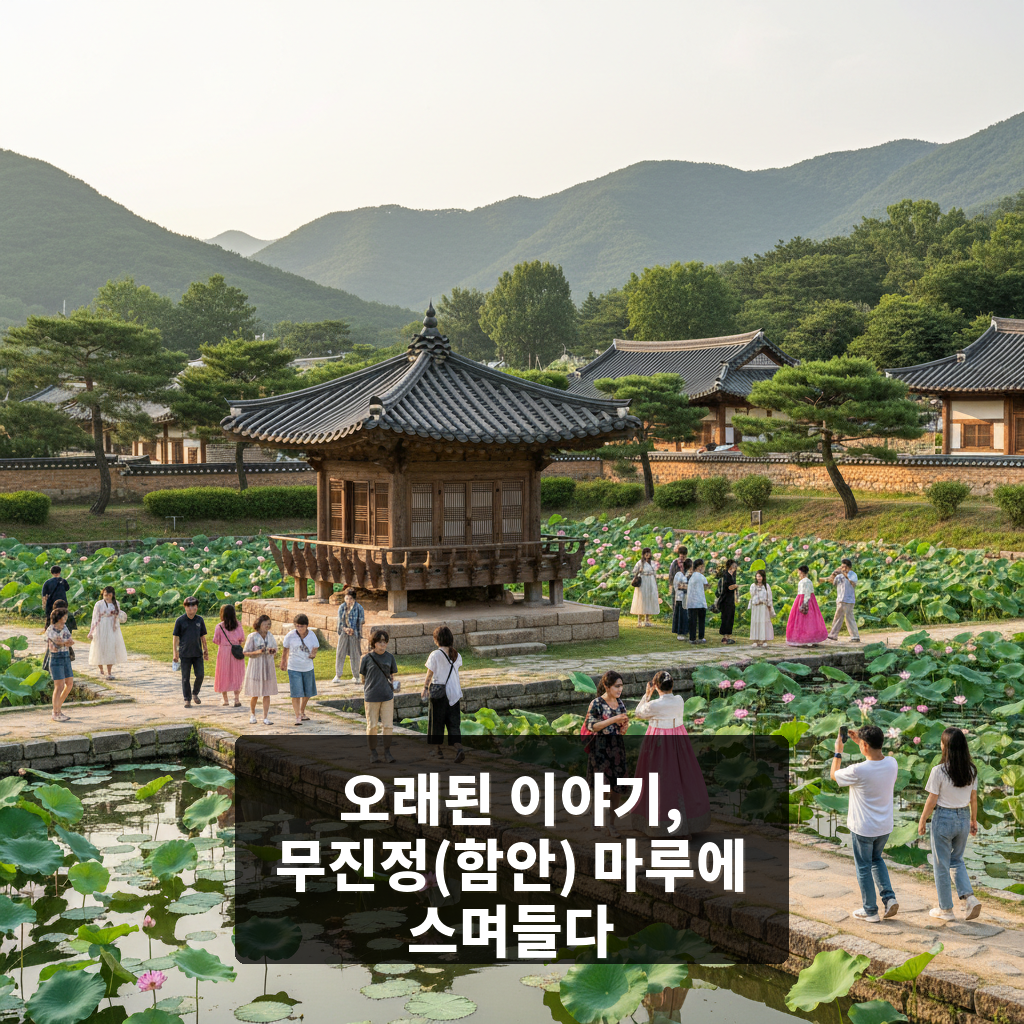
Mujinjeong (Haman) captures attention with its restrained beauty rather than splendor. With a modest size of 3 bays in the front and 2 bays on the sides, the sense of stability provided by its hip-and-gable roof, which resembles the Chinese character for ‘eight’ on its sides, harmonizes with the surrounding nature to present a picturesque scene. In particular, the simple and modest architectural style, without any decorations or carvings on the columns, is a valuable example that well represents the pavilion style of the early Joseon Dynasty.
The pavilion’s floor is entirely in the numaru style, a raised wooden floor, providing optimal conditions for enjoying artistic refinement with cool breezes passing through in the hot summer. The central bay of the front is designed as a marubang (wooden floor room) rather than an ondol room (underfloor heated room), allowing one to imagine scholars sitting here, gazing at the distant scenery and reciting poetry. The building we see today was rebuilt in April 1929, preserving its unchanging beauty through long years.
A Special Journey to Meet Mujinjeong (Haman)
Klook.com

To fully appreciate the tranquil atmosphere of Mujinjeong (Haman), it is best to slow your steps and deepen your gaze. This is because it is more than just a sight; it is a space for contemplation where the past and present intersect. Mujinjeong, located at 13, Goesan 4-gil, Haman-myeon, Haman-gun, welcomes visitors with its beautiful surrounding nature.
New Scenery Everywhere You Go
- Haman Lotus Theme Park In summer, a splendid spectacle of lotus flowers unfolds, offering a different beauty from Mujinjeong, where you can experience the contrast between tranquility and splendor.
- Haman Museum A place where you can deeply understand the history and culture of the Haman area, where Mujinjeong is located; it is recommended to visit before or after seeing the pavilion.
Mujinjeong, Embracing Tranquility, Here’s How to Get There
Mujinjeong is located near 517-1, Goesan-ri, Haman-myeon, Haman-gun. If using public transportation, take a city bus towards Haman-myeon from Haman Intercity Bus Terminal, or if using a private car, you can easily arrive by searching for ‘Mujinjeong’ on your navigation system. Parking is free, and there is no separate admission fee, so anyone can visit comfortably.
Visiting Mujinjeong (Haman), Remember This!
- Best Time to Visit Spring and autumn are the most beautiful times for the natural scenery around the pavilion. Red autumn leaves or lush fresh greenery harmonize with the pavilion, creating a picturesque view.
- Viewing Hours You can visit freely from after sunrise until before sunset, but for safety, it is best to avoid visiting after dark.
- What to Prepare Wear comfortable shoes and prepare for a pleasant walk with a light heart. It’s also nice to bring some water or tea and enjoy some leisurely time sitting in the pavilion.
- Etiquette As it is a building with historical value, please be careful not to damage it and observe the etiquette of quiet viewing for other visitors.
- Photography Visiting in the morning when the natural lighting is good will allow you to take even more wonderful photos. Capture the tranquil atmosphere of the pavilion.
True ‘Rest’ Found at Mujinjeong (Haman)
If you wish to escape from your busy daily life and spend some quiet time, Mujinjeong (Haman) will be the best choice. Sit on its wooden floor, feel the passing breeze, and take time for self-reflection while tracing the footsteps of ancient scholars. Just like Scholar Jo Sam, who embraced a boundless spirit, the serenity and inspiration gained here will bring a small resonance to your daily life. We hope you experience true ‘rest’ and carry away the rich scent of history from this tranquil pavilion, embracing 500 years of time.
Frequently Asked Questions
Q1. Which historical figure was Mujinjeong built to commemorate?
Mujinjeong was built in 1567, the 22nd year of King Myeongjong of Joseon, by his descendants to commemorate the virtue of Scholar Jo Sam, whose pen name was Mujin (無盡). It was named after his pen name.
Q2. What are the architectural characteristics of Mujinjeong?
It is a hip-and-gable roof building with 3 bays in the front and 2 bays on the sides, showcasing a simple and modest early Joseon Dynasty pavilion style with no decorations or carvings on the columns. In particular, the floor is entirely in the numaru style (raised wooden floor).
Q3. Is there an admission or parking fee when visiting Mujinjeong?
No, Mujinjeong can be visited for free, and parking is also available at no charge. You can visit without any burden and feel the breath of history.
Q4. Are there any other places worth visiting around Mujinjeong?
Yes, nearby you can find Haman Lotus Theme Park, where you can see splendid lotus flowers in summer, and Haman Museum, where you can learn about the local history, both of which are good to visit together.
Q5. What is the best time to visit Mujinjeong?
The fresh greenery of spring and the autumn leaves harmonize with the pavilion to present the most beautiful scenery. It is a good season to spend peaceful time in contemplation amidst the tranquil atmosphere.
 Love Korea? Promote it & Earn.