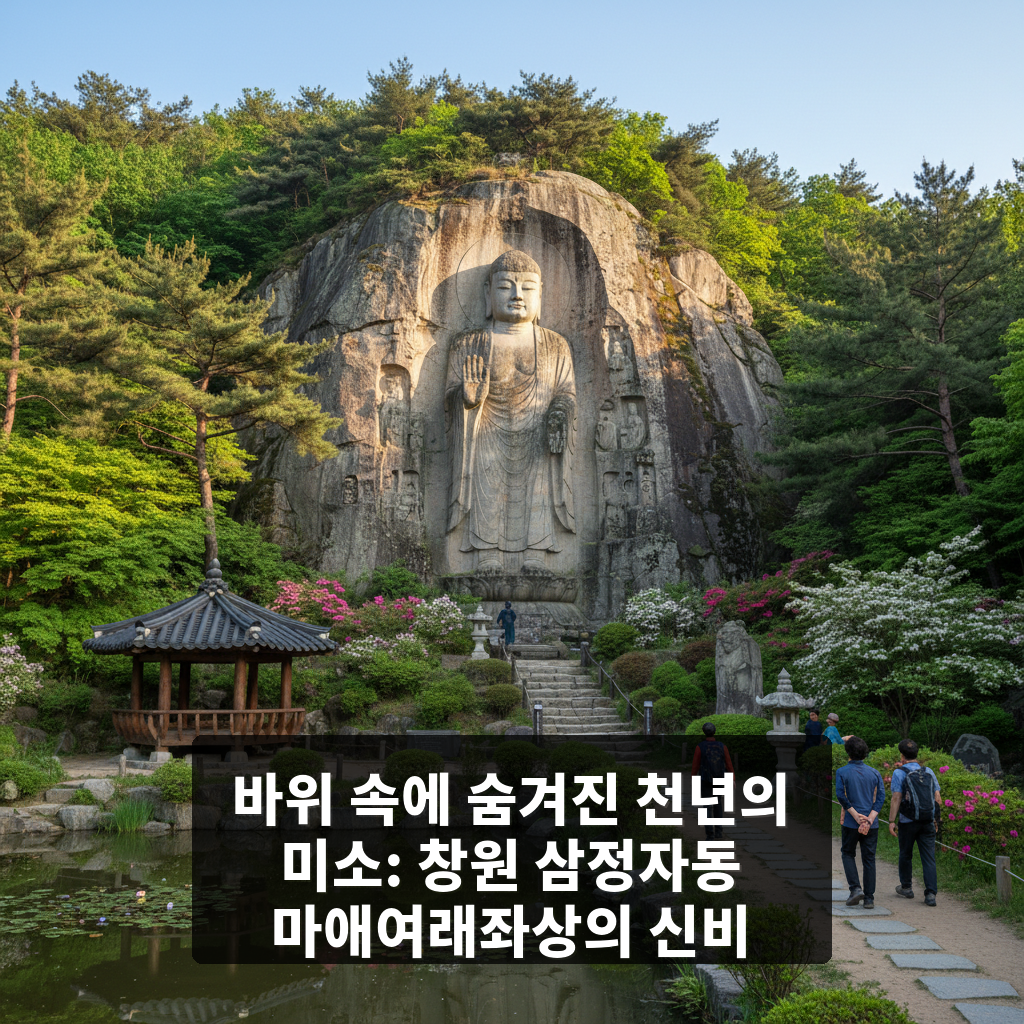
A thousand-year smile hidden in the rock: The mystery of the Samjeongjadong Rock-Carved Seated Buddha in Changwon


Imagine. How would you feel if, in the middle of a quiet, secluded valley, on a colossal rock, a meticulously carved Buddha’s face, enduring a thousand years, looked upon us? Right here, in Naeri Village, Samjeong-dong, Changwon, quietly nestled as if forgotten by time, is the Changwon Samjeong-dong Maae-yeoraejwasang, which offers such an impression.
The fact that a Buddha statue carved into a rock can be more than just a religious sculpture, but a historical record embodying the aspirations and artistic spirit of the people of that time, always makes us solemn. What stories of that era can we truly glimpse through this rock-carved Buddha? And why, of all places, was such a great cultural heritage created deep in these mountains?
From now on, let’s find the answers and embark together into the ancient secrets held by the Changwon Samjeong-dong Maae-yeoraejwasang.
Buddha’s Heart Blossoming on a Colossal Rock, The Mysterious Appearance of the Maae-yeoraejwasang
This rock-carved Buddha, carved in relief on a granite rock called ‘Janggunbawi’ in the middle of Naeri Village valley, Samjeong-dong, instills a natural sense of reverence in those who behold it. Measuring a considerable 159cm, it vividly depicts the figure of Buddha carved into one side of the rock. Amidst the traces of time visible to the naked eye, one can glimpse the outstanding skill and Buddhist devotion of the artisan of that era.
Traces of Time and Characteristics of the Buddha Statue
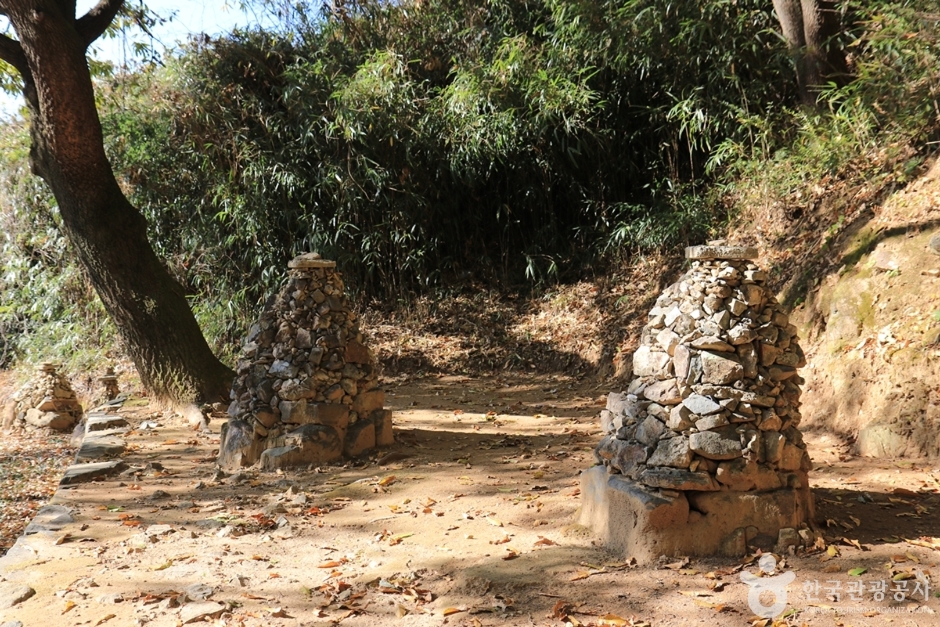
- Head Shape Above the head, twisted like a conch shell, remains the usnisa (육계), protruding like a topknot. This is one of the important elements symbolizing the Buddha’s dignity.
- Face and Neck Unfortunately, part of the right cheek is damaged, but there are distinct traces of self-inflicted wounds on the forehead. On the neck, three folds, namely samdo (三道), are clearly expressed, indicating the state of enlightenment.
- Dharma Robe (法衣) The front chest area is severely exfoliated (剝落), making it difficult to discern the exact form, but after covering both knees, it naturally flows down to the pedestal, expressed with three overlapping U-shaped folds. Its somewhat schematic yet elegant sculptural beauty stands out.
- Mudra (手印) The left hand rests comfortably on the knee, and the right hand forms the bhumisparsha mudra (降魔觸地印), pointing towards the ground. This posture symbolizes the moment the Buddha attained enlightenment, overcoming all worldly delusions.
Details of the Halo and Pedestal Surrounding the Buddha Statue
The Changwon Samjeong-dong Maae-yeoraejwasang is equipped with both a halo (光背), which expresses the light emanating from the Buddha’s body, and a pedestal (臺座), which represents the seated position. The halo is in the form of a ‘great body halo’ (거신광), possessing both a head halo (두광) and a body halo (신광), and its lack of special ornamentation within gives it a more simple and majestic feel.
The pedestal appears hexagonal, and in the middle section, three pillars are expressed in relief, adding a sense of three-dimensionality. Such detailed expression methods clearly demonstrate the high level of Buddha sculpture at that time.
A Thousand-Year Time Travel, Feeling the Breath of the Unified Silla Period
This rock-carved Buddha is currently presumed to date from the Unified Silla period. The Unified Silla period was when Buddhist art flourished most, with a strong tendency to realistically depict the ideal image of the Buddha. The Changwon Samjeong-dong Maae-yeoraejwasang also fully embodies these characteristics of the era.
What are the Aesthetic Characteristics of Unified Silla Buddha Statues?
- Realistic Expression Unified Silla Buddha statues are characterized by realistic and three-dimensional expressions, emphasizing human bodily proportions and harmony. Such techniques can also be seen in this rock-carved Buddha.
- Plump Face and Voluminous Figure To express the Buddha’s compassion and dignity, they often featured full and round faces and supple figures.
- Elaborate Robe Folds The folds of the dharma robe are characterized by their realistic yet flowing elegance, and this flow can also be observed in the U-shaped dharma robe depiction of the Changwon Samjeong-dong Maae-yeoraejwasang.
- Bhumisparsha Mudra The bhumisparsha mudra, which expresses the moment Shakyamuni Buddha attained enlightenment, is one of the mudras frequently appearing in Unified Silla Buddha statues.
Discovery in a Serene Forest, Visiting the Changwon Samjeong-dong Maae-yeoraejwasang
The Changwon Samjeong-dong Maae-yeoraejwasang is located at 79, Yonggang-gil 79beon-gil, Dong-eup, Uichang-gu, Changwon-si, Gyeongsangnam-do. Situated in a tranquil spot slightly removed from the city center, the journey to find the Buddha statue itself can be a small healing trip.
Following the winding country roads, you’ll soon find yourself deeply immersed in nature. The experience of encountering the Buddha statue while walking through the forest path offers a different resonance than the impression felt in typical museums or temples.
A Journey to Find a Hidden Treasure
If using public transportation, you can take a bus from downtown Changwon, get off near Samjeong-dong, and then walk up along the village road. If using a private car, you can access the entrance of Naeri Village relatively easily, but there may be sections where you need to walk to reach the Buddha statue. For the exact location, please refer to Map below.
Please note that this area boasts beautiful rural scenery, so it is recommended to allow ample time to enjoy the surrounding landscape during your visit. Especially in autumn, the autumn foliage creates a spectacular view, allowing you to encounter even more beautiful scenery.
Visiting Tips for a Serene Experience
When visiting cultural heritage sites of high historical value, knowing a few things in advance can enrich your experience. The same applies when visiting the Changwon Samjeong-dong Maae-yeoraejwasang.
Checklist for a Deeper Encounter with the Rock-Carved Buddha
- Comfortable Clothing and Footwear As it is located in the middle of a valley, you may need to walk uphill or on forest paths. It is advisable to prepare comfortable sneakers and casual clothing.
- Photography Etiquette As it is a precious cultural heritage site located in nature, it is important to observe it quietly and reverently, being careful not to damage the surrounding environment. Please refrain from using tripods or excessive photography.
- Seasonal Preparations In summer, it is good to bring insect repellent for mosquitoes and other pests, and in autumn/winter, warm clothing. Convenience facilities such as water fountains may be lacking, so bringing a personal water bottle is also a good idea.
- Learning Historical Background If you briefly learn about the rock-carved Buddha and Buddhist art of the Unified Silla period before your visit, you can understand and appreciate the statue more deeply on site.
Beauty Carved by Time, Creating Unforgettable Memories
Having silently endured a thousand years in a secluded place, the Changwon Samjeong-dong Maae-yeoraejwasang conveys more than just a mere stone to us. The Buddha’s smile, blossoming from the rugged rock, delivers an even more powerful message amidst the tranquility, offering peace and comfort to those of us weary from busy daily lives.
Here, reflecting on the delicate carvings of the rock-carved Buddha and the stories they contain, one by one, we hope you take a precious moment to encounter a timeless artistic spirit. Undoubtedly, Changwon’s hidden treasure, the Changwon Samjeong-dong Maae-yeoraejwasang, will remain a beautiful and lasting memory in your mind.
Frequently Asked Questions
Q1. In what era was the Changwon Samjeong-dong Maae-yeoraejwasang created?
Considering its sculptural style and detailed expression, this rock-carved Buddha is presumed to have been created during the Unified Silla period. It is an important relic that clearly shows the characteristics of Buddhist art of that time.
Q2. Is the location of the Maae-yeoraejwasang difficult to visit by public transportation?
While not entirely remote, if using public transportation, there may be sections where you need to walk a bit after getting off the bus. Using a private car might be more convenient.
Q3. Are there any specific points to be aware of when visiting?
As it is a cultural heritage site located in nature, care must be taken not to damage the surrounding environment, and it should be observed quietly. Especially in summer, it is advisable to prepare for mosquitoes and other pests.
Q4. Are there other attractions near the Maae-yeoraejwasang?
Naeri Village in Samjeong-dong, where the rock-carved Buddha is located, itself boasts a quiet and tranquil rural landscape. Nearby, there are places like Changwon Junam Reservoir and Dangam Theme Park, which can be visited together.
Q5. What is the preservation status of the Maae-yeoraejwasang?
Due to its characteristic of being carved in relief on granite, it has undergone weathering over a long period, but its main form is relatively well-preserved. However, some parts of the face and the dharma robe are in a state of exfoliation.