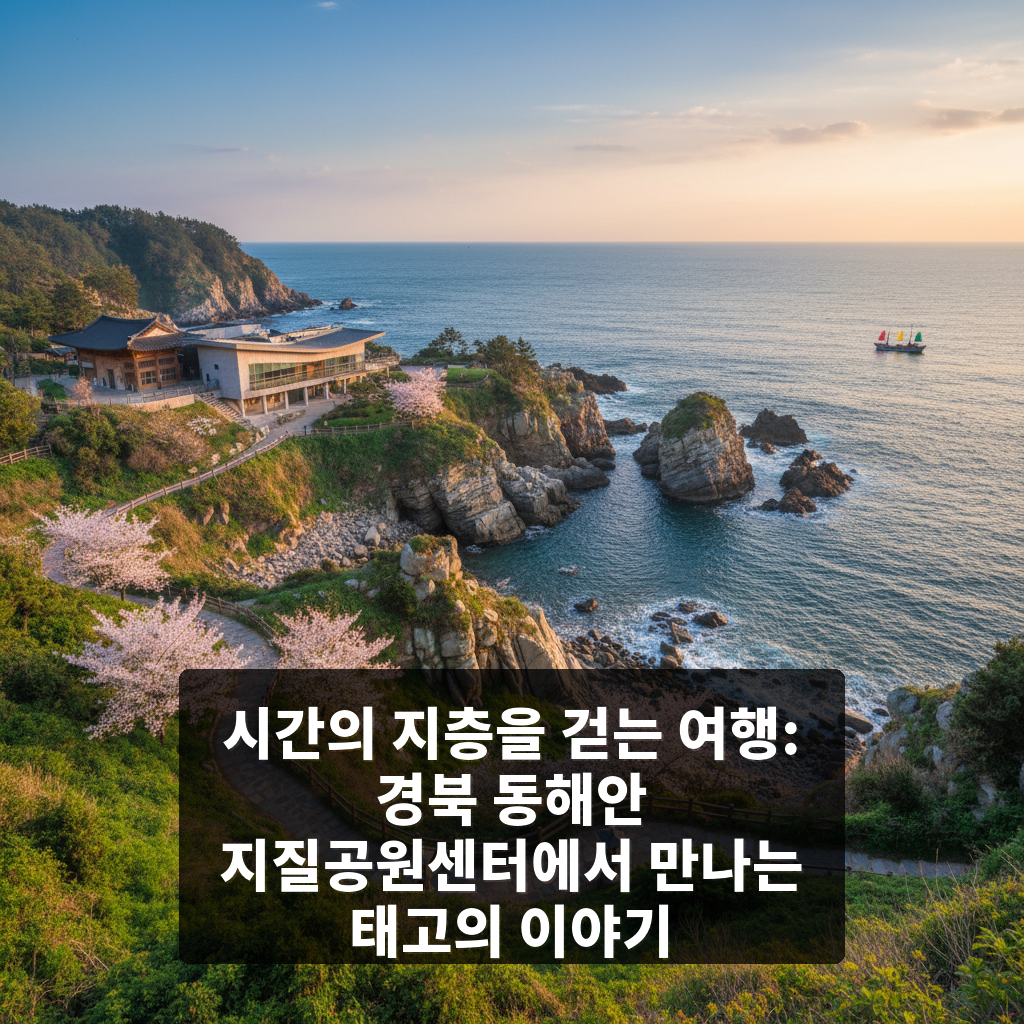
A journey through the geological strata of time: An ancient story encountered at the Gyeongbuk East Coast Geopark Center


Have you ever imagined an artwork created by the dynamic power of nature? The land of the Korean Peninsula, which has continuously changed from hundreds of millions of years ago to the present, especially the East Coast, holds a special geological drama. Here, Gyeongbuk East Coast Geopark Center is more than just an exhibition space; it’s the starting point of a sensory journey that allows us to experience the Earth’s secrets breathing beneath our feet with all five senses.
The magnificent terrain created where the sea and land meet, traces left by prehistoric creatures, and even the fiery breath of volcanic activity. The Gyeongbuk East Coast Geopark Center gathers all these wonderful stories and guides visitors into primordial times. Here, we will feel the Earth’s grand narrative with our whole bodies and discover a new sense of awe for nature.
As a core base facility for UNESCO Global Geopark designation, Gyeongbuk East Coast Geopark Center covers the vast area of the Gyeongbuk East Coast Geopark and serves as an excellent guide for exploring Korea’s largest geological heritage, distributed across four local governments: Uljin, Yeongdeok, Pohang, and Gyeongju.
Gyeongbuk East Coast Geopark Center, what stories does it hold?
Gyeongbuk East Coast Geopark Center is a core facility of the vast geopark spread along the East Coast of Gyeongsangbuk-do. It can be described as a living geological heritage museum where various rocks ranging from the Precambrian Era to Cenozoic Era coexist with artifacts and cultural assets from prehistoric and historical periods. This park, with a total area of 2,629.66㎢, boasts the largest scale in Korea, offering visitors the opportunity to fully feel the Earth’s breath.
The Birth of the East Sea, Art Created by Tectonic Shifts


- Korea-Japan Separation Process In the past, the Korean Peninsula and Japan were connected and then separated, forming the East Sea, and the traces of enormous geological changes caused by this remain intact on the present Gyeongbuk East Coast.
- Traces of Volcanic Activity Geotectonic activity related to the formation of the East Sea triggered vigorous volcanic activity. As a result, magnificent terrains such as Daljeon-ri Columnar Joints and Yangnam Columnar Joints, and features created by volcanic eruptions like Guryongso, Homigot, and Golgulsa Temple were born.
Exploring Geological Heritage Against the Flow of Time
Gyeongbuk East Coast Geopark Center allows us to go back in time and encounter the marvelous geological heritage of the East Coast. It is a special experience to encounter not just simple stones, but the Earth’s testimonies holding stories of hundreds of millions of years.
Whispers of Forgotten Life
Klook.com

As sediments accumulated in the rift between the Korean Peninsula and Japan, the organisms buried within became precious fossils in Cheoram-san and Duho-dong, vividly testifying to the appearance of past ecosystems. As if turning the thick pages where the Earth’s history is written, here you can encounter primeval life.
The Drama of Topographical Changes Created by the Development of the East Sea
- Homigot’s Coastal Terraces The development of the East Sea caused topographical changes in coastal areas, and a prime example of this is the beautiful coastal terraces formed at Homigot. It is like a work of art created by the sea and land pushing and pulling each other over a long period.
- Movement of Cheoram-san Fossils The Cheoram-san fossils, which were once at the bottom of the sea and rose to the mountaintop due to tectonic shifts, are a prime example of the dynamism of geological activity. Even now, the East Coast continues to change with rough waves, creating new landforms.
Gyeongbuk East Coast Geopark Center, Tips for a Fully Enjoyable Visit
Inside the center, various exhibitions and experiential programs are provided to help visitors easily and enjoyably understand the vast information about the geopark. Beyond simply listing information, it is designed to allow visitors to directly see and feel geological phenomena through interactive exhibits and visual materials. Especially if you visit with children, it will be a place for lively science education.
Must-See Viewing Points
- Overall View of the Geopark Inside the center, look for large maps or miniatures that allow you to grasp the topographical features and major geological sites of the entire Gyeongbuk East Coast Geopark at a glance. This will be a great help in planning your route.
- East Sea Formation Process Simulation Enhance your understanding through visually implemented videos that show how the East Sea was formed and what geological phenomena occurred during that process.
- Fossil Specimen Observation Take time to observe various fossil specimens discovered in Cheoram-san and Duho-dong up close and immerse yourself in the mystery of ancient life.
- Geological Experience Programs (Availability and content need to be confirmed) If there are programs you can directly participate in, such as touching geological rocks or volcano eruption model experiments, it will be an even more memorable experience.
Around the Center, Other Unmissable Attractions
While visiting Gyeongbuk East Coast Geopark Center, we recommend exploring the surrounding geological sites as well. The experience of directly witnessing geological wonders in the actual field, based on the knowledge gained at the center, will be more valuable than any exhibition.
- Daljeon-ri Columnar Joints The Daljeon-ri Columnar Joints, located in Pohang, are a spectacular sight of distinct hexagonal pillars, a natural sculpture formed as hot lava cooled. Apply the knowledge you learned at the center to the field.
- Yangnam Columnar Joints The Yangnam Columnar Joints in Gyeongju are a unique attraction where you can see various forms of columnar joints, such as fan-shaped and horizontal types. The sight of the columnar joints harmonizing with the sound of the waves will create unforgettable memories.
- Homigot Homigot, located at the easternmost tip of the Korean Peninsula, is famous for its sunrise, but its coastal terraces also hold significant geological value. Appreciate the coastal topography harmonizing with the vast sea and feel the Earth’s dynamism.
A Journey to Feel the Earth’s Pulse, Directions
The Gyeongbuk East Coast Geopark Center is the starting point of a journey to explore the Earth’s mysteries. Visit in person and experience this amazing geological heritage. You can find the exact location on the map below.
Checklist for a Comfortable Visit
- Using Public Transportation Be sure to check public transportation information before your visit for comfortable travel. It’s advisable to inquire about connecting transportation from nearby bus stops or train stations.
- Parking when Using a Personal Car If you are using a personal car, it is recommended to check whether parking facilities are available within or near the center before visiting. It may be crowded on weekends or holidays.
- Check Operating Hours Before visiting, be sure to check the exact operating hours and closing days of the Gyeongbuk East Coast Geopark Center on its website to avoid a wasted trip. Operating hours may change, especially during holiday periods or specific seasons.
- What to Bring Since the visit is mainly indoors, no special preparations are needed, but if you plan to explore the surrounding outdoor geological sites, it is advisable to prepare comfortable shoes, a hat, drinking water, etc.
Frequently Asked Questions
Q1. What kind of place is the Gyeongbuk East Coast Geopark Center?
The Gyeongbuk East Coast Geopark Center is a core facility of the Gyeongbuk East Coast Geopark, serving as a base for UNESCO Global Geopark designation. It is a place that exhibits and educates about various geological heritages from the Precambrian to the Cenozoic eras, as well as the formation process of the East Sea.
Q2. How big is the Gyeongbuk East Coast Geopark?
The Gyeongbuk East Coast Geopark spans four local governments: Uljin, Yeongdeok, Pohang, and Gyeongju, boasting the largest scale in Korea with a total area of 2,629.66㎢. You can encounter sites of geological value within its vast natural landscape.
Q3. What are the main geological sites that can be seen at the center?
At the center, you can learn about the Earth’s history through various volcanic activity landforms resulting from the formation of the East Sea, such as Daljeon-ri Columnar Joints, Yangnam Columnar Joints, Guryongso, Homigot, and Golgulsa Temple, as well as fossils discovered in Cheoram-san and Duho-dong.
Q4. Are there any good places to visit near the Gyeongbuk East Coast Geopark Center?
Yes, after visiting the center, we recommend experiencing the grandeur of actual geological sites by visiting places such as Pohang Daljeon-ri Columnar Joints, Gyeongju Yangnam Columnar Joints, and Homigot, where you can see beautiful coastal terraces.
Q5. Is it suitable to visit with children?
Yes, the Gyeongbuk East Coast Geopark Center is an excellent educational venue, well-equipped with visual materials and experiential exhibits that children will find engaging. It will be very effective in fostering curiosity about Earth science.
 Love Korea? Promote it & Earn.