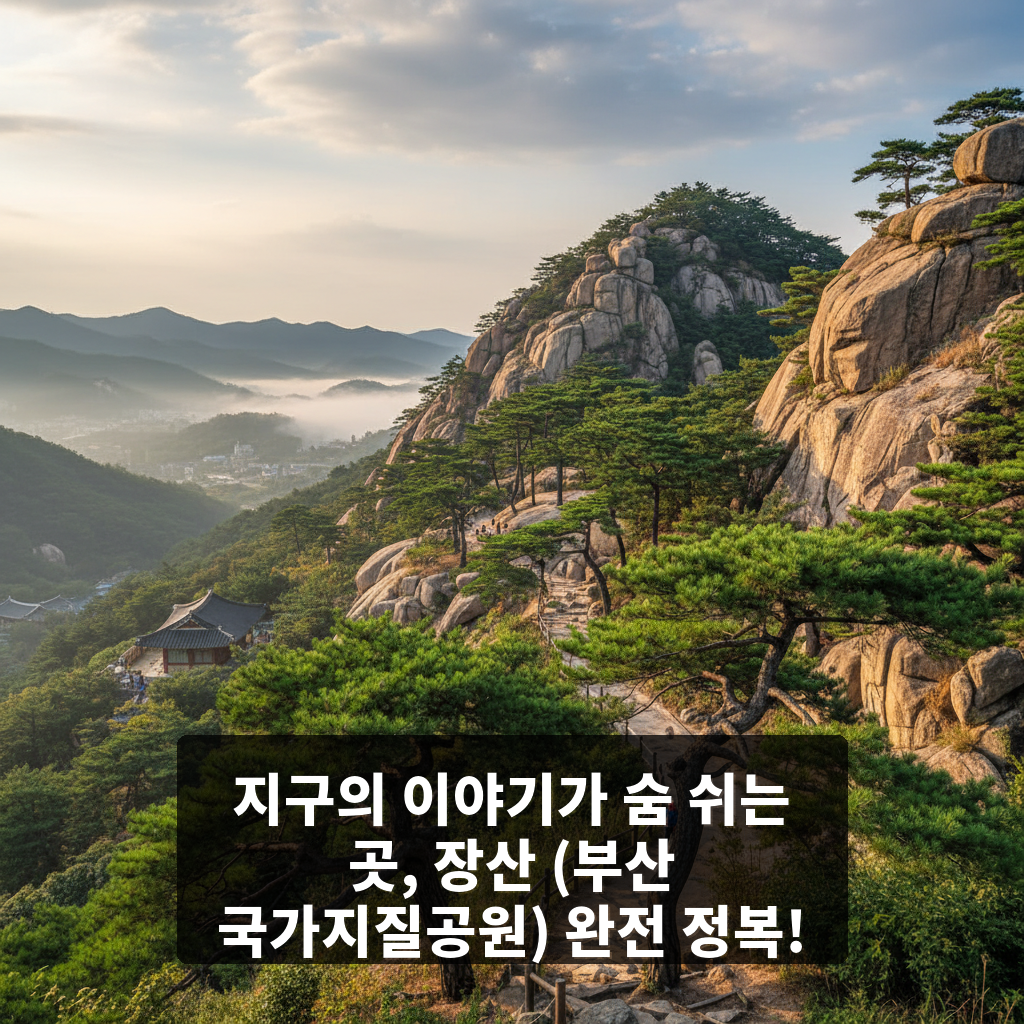
Jangsan, a place where the Earth’s story breathes (Busan National Geopark), Complete Guide!


Do you know that in the heart of Busan, embracing the sea and the city at a glance, there’s a place imbued with hundreds of millions of years of Earth’s breath within it? It’s the story of Jangsan (Busan National Geopark). Jangsan, rising majestically from Busan’s city center overlooking the South Sea, is more than just a beautiful mountain; it effectively serves as a living geological museum and the best observatory.
Beyond just viewing the open Haeundae Marine City and the magnificent Gwangandaegyo Bridge, this place, which fully preserves the traces of volcanic activity from the late Cretaceous period, gifts us the wonders of nature. If you want to turn an ordinary weekend into a special exploration, pay attention to the journey to Jangsan.
Whether you want to explore the Earth’s history or simply seek healing amidst breathtaking scenery, Jangsan is ready to fulfill all your expectations. From now on, let’s uncover each of Jangsan’s charms one by one.
A Masterpiece Sculpted by Time, the Geological Mystery of Jangsan
Jangsan (Busan National Geopark) is not just a magnificent mountain. It is like a living geological textbook, composed of volcanic ash, lava, and pyroclastic flows erupted from rhyolitic volcanic activity. The moment you step onto Jangsan, you are walking into the traces of the violent changes the Earth experienced millions of years ago.
Traces Left by Volcanic Activity
- Diverse Volcanic Rocks: As evidence of rhyolitic volcanic activity, unique and magnificent volcanic rocks can be found everywhere.
- Jangsan Falls and Dolseoreong: Jangsan Falls and Dolseoreong, which highlight the characteristics of volcanic topography, are representative attractions that allow one to feel the grandeur of nature.
- Caldera Remnant Structure: Jangsan is a volcanic collapse structure, a remnant caldera from the late Cretaceous period, holding very important academic value for studying the history of volcanic activity in the southeastern Korean Peninsula.
Particularly impressive among Jangsan’s topography are the rockslides. The sight of huge rocks that have fallen from volcanic rock cliffs, stretching long along the mountain slopes, creates a spectacular scene as if a giant has poured out stones. These rockslides are divided into a total of nine branches, and are a magnificent sight in themselves.
Jaesongneodeol-gil, a Path Walking Along the Sea and the Rockslides
If you want to truly appreciate Jangsan’s rockslides, try walking the ‘Jaesongneodeol-gil’ trail. This trail was created by connecting each of the rockslides, offering a special experience where you can simultaneously enjoy the refreshing views of the South Sea and the East Sea throughout your walk. It can be said that this is Jangsan’s unique charm, allowing you to enjoy both geological beauty and coastal city views simultaneously.
A Panorama Unfolding Beneath Your Feet, Busan’s Scenery Encountered at Jangsan
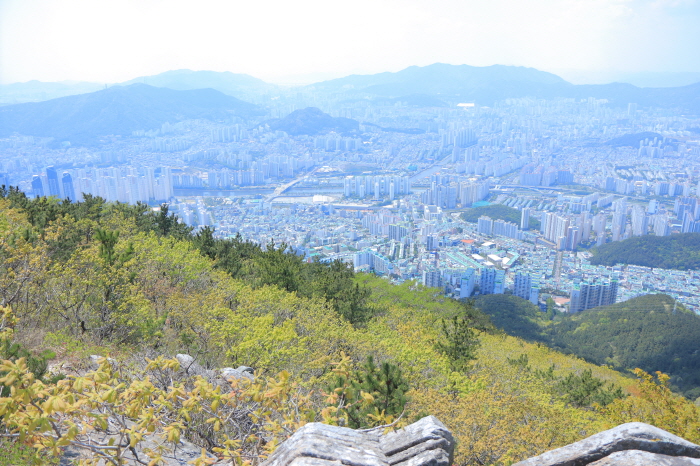
When you climb Jangsan (Busan National Geopark), iconic Busan landscapes unfold before your eyes like a panorama. This magnificent view, granted only to those who ascend with effort, is truly moving in itself.
Capturing Busan’s Landmarks at a Glance
Standing at Jangsan’s peak, the high-rise building forest of Haeundae Marine City and the magnificently stretching Gwangandaegyo Bridge come into view at a glance. By day, the vibrant city scene harmonizes with the blue sea; by night, the dazzling city lights and the night view of Gwangandaegyo Bridge create a fantastic contrast. Especially at sunset, the twilight dyes the sky and sea crimson, offering unforgettable memories.
| Season | Charms to experience at Jangsan |
|---|---|
| Spring | Vibrant scenery with fresh sprouts emerging. Pleasant hiking under warm sunlight. |
| Summer | Cool breeze and lush green forest paths. The refreshing feeling of the blue sea viewed from the summit. |
| Autumn | Mountain slopes ablaze with colorful autumn foliage. Enjoying clear views of Busan city center and the sea with excellent visibility. |
| Winter | The tranquility of a snow-covered landscape (rarely). Enjoying wide-open views with crisp and clear visibility in the cold air. |
No matter the season you visit, Jangsan welcomes visitors, showcasing its unique beauty. Jangsan’s scenery, which changes its attire with each season, will always offer new inspiration whenever you visit.
A Healing Spot in the City Center, Jangsan (Busan National Geopark) Exploration Guide
Jangsan (Busan National Geopark) is located in Haeundae-gu, Busan, making it highly accessible. Thanks to the advantage of being able to deeply experience nature even within the city, it has established itself as a popular destination for many citizens and tourists.
Getting to Jangsan & Various Hiking Trails
Jangsan has a wide range, with various hiking trails developed. A major advantage is being able to choose a desired course according to one’s physical condition and time. You can easily reach the starting point using public transportation, and if driving, you can utilize nearby parking facilities. (It is recommended to check the exact location and parking information before visiting.)
Recommended Hiking Trails (Examples)
- Daecheon Park Course: This is the most common and well-maintained course, leading to the summit via Jangsan Falls. It is suitable for family visitors.
- Ongnyeobong Course: This course allows you to enjoy open views in a relatively short time. It’s great for viewing the sea while enjoying a cool breeze.
- Jaesongneodeol-gil Course: As introduced earlier, this is a special course where you can walk while experiencing geological value. If you wish to explore the mysteries of nature, this course is recommended.
Since each course has different estimated times and difficulty levels, it’s advisable to check the information and prepare beforehand. Whichever course you choose, Jangsan will present you with unforgettable memories and refreshing energy.
Checklist for a Pleasant Hike
- Comfortable Hiking Shoes: Wear comfortable shoes as there may be steep or rocky sections.
- Plenty of Water and Snacks: Hydration is essential during hiking! Simple energy bars or fruits are also good.
- Appropriate Clothing for Weather Conditions: The mountain summit can be windy, so it’s advisable to bring a light jacket.
- Map or Navigation App: Prepare these in advance to avoid getting lost among the various trails.
- Trash Bag: Have the common sense to take your trash back with you! Let’s protect clean nature together.
Busan’s Beautiful Nature Encountered at Jangsan
Jangsan is not just a mountain; it’s a special place where the wonders of nature and the vibrancy of the city coexist. If you want to escape the bustling city for a while and recharge in nature, why not embark on a journey to Jangsan (Busan National Geopark)?
From the open sea and city panorama to geological heritage preserving hundreds of millions of years of history. Jangsan is a true gem of Busan, offering a feast for all five senses to its visitors. On your next trip to Busan, we hope you create new memories at Jangsan.
Frequently Asked Questions
Q1. What are the most significant features of Jangsan (Busan National Geopark)?
Jangsan boasts unique geological structures formed by volcanic activity in the late Cretaceous period. Its most significant features are the ability to simultaneously enjoy diverse volcanic rocks, rockslides, and excellent coastal city views encompassing Haeundae and Gwangandaegyo Bridge.
Q2. What hiking trails are available at Jangsan?
Jangsan offers trails with various difficulty levels and themes, including general courses starting from Daecheon Park, the Ongnyeobong Course, and the Jaesongneodeol-gil Course which follows the rockslides. Visitors can choose according to their physical condition and purpose.
Q3. What academic value does Jangsan (Busan National Geopark) hold?
Jangsan is a volcanic collapse structure, a remnant caldera from the late Cretaceous period, holding very important academic value for studying the history of volcanic activity in the southeastern Korean Peninsula. In particular, the rockslides are valuable data for observing geological formation processes.
Q4. What scenery can be seen from Jangsan’s peak?
From Jangsan’s peak, you can take in a panoramic view of Haeundae Marine City’s high-rise building forest, the magnificent appearance of Gwangandaegyo Bridge, and the vast expanse of the South Sea. It is particularly famous for its beautiful sunsets and night views.
Q5. Are there any specific points to note when visiting Jangsan (Busan National Geopark)?
While Jangsan’s hiking trails are well-maintained, there are some steep sections, so it’s advisable to wear comfortable hiking shoes and bring plenty of water and snacks. Additionally, for nature conservation, it is important to take your trash back with you.