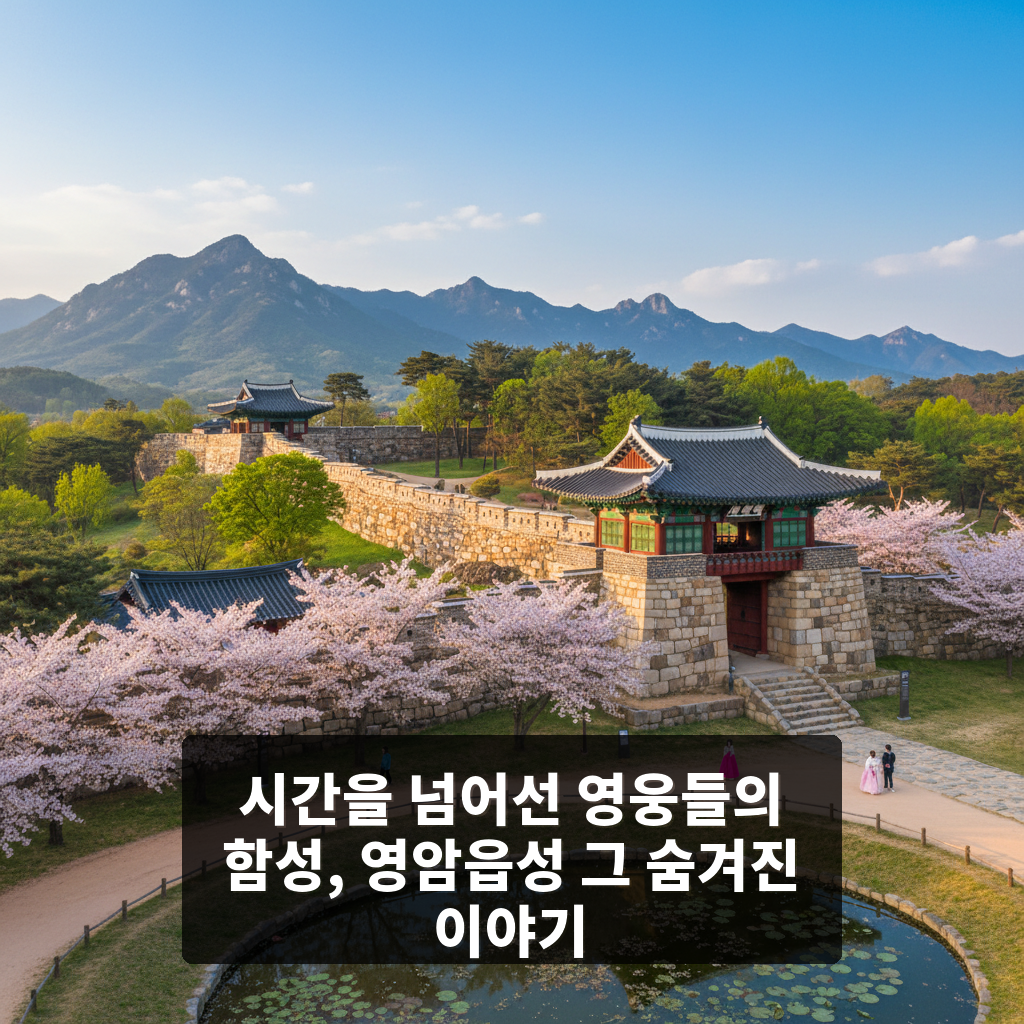
The roar of heroes transcending time, Yeongam Eupseong, its hidden story


What story do the traces of time, accumulated layer by layer in the cracks of the old fortress walls, tell us? What can we discover today amidst forgotten names and the remnants of bygone eras? In Yeongam, Jeollanam-do, Yeongam-eupseong, imbued with the sweat and tears of countless people and the spirit of courageous righteous army soldiers, stands quietly.
This is not just a stone wall. It was first built at the end of the Goryeo Dynasty to defend against Japanese pirates, and during the Joseon Dynasty, it was reborn on a grand scale, twice the size of a military garrison. It was once a fierce battlefield where ordinary people fought for their lives against foreign invasions, and a historical site where an indomitable spirit of resistance thrived.
Today, we would like to look into a cross-section of history hidden behind its massive walls and explore what message Yeongam-eupseong conveys to us today.
A Stone Wall Embracing a Thousand Years of History, Time Travel at Yeongam-eupseong
Yeongam-eupseong began to be built at the end of the Goryeo Dynasty to protect the lives of the people against continuous invasions by Japanese pirates. Later, entering the Joseon Dynasty, a large-scale construction project to expand the existing fortress walls began in 1427, and finally, in 1451, all parts except the ongseong (crenelated wall) and moat were completed. Its scale was truly overwhelming, reaching a total length of 2,010m, making it a massive fortress twice the size of military garrisons at the time.
Secrets of Fortress Construction Techniques Hidden in the Grand Scale


The construction method of Yeongam-eupseong, revealed through excavation in 2009, clearly demonstrates the architectural technology of Joseon Dynasty eupseong (town fortresses) at the time. The outer wall of the fortress was built by excavating hills and solidly stacking stone, while the inner wall was reinforced by compacting excavated soil at an incline, a method known as ‘naetak (inner embankment)’. This construction method was a wise technique that enhanced the stability of the fortress walls and maximized defensive capabilities.
- Construction Period Began in late Goryeo Dynasty, expansion work started in 1427, completed in 1451 (excluding ongseong and moat)
- Fortress Scale Total length 2,010m, approximately twice the size of military garrisons at the time
- Construction Method Outer wall: stone masonry, Inner wall: ‘naetak (inner embankment) method’ using soil from the hills
- Current Location Distributed across the areas of Dongmu-ri, Seonam-ri, Nampung-ri, and Yeok-ri in Yeongam-eup (some sections remain behind the current Mudeung Apartment and the cathedral)
The Cry of the Eulmyo Waebyeon, the Indomitable Will that Protected Yeongam-eupseong
The history of Yeongam-eupseong cannot be discussed without mentioning the great ordeal of the ‘Eulmyo Waebyeon’ in 1555. At that time, Japanese pirates, who had captured over 10 fortresses in Jeollado and advanced triumphantly, besieged Yeongam-eupseong. In a desperate crisis, the people of Yeongam had to endure a painful siege, unable to drink a single drop of water.
It was then that General Yang Dalsa, recorded as the first righteous army commander of Joseon, stepped forward. General Yang Dalsa steadfastly fought alongside the exhausted citizens of Yeongam, and finally, on May 25th, achieved the ‘Yeongamseong Great Victory’ by defeating the Japanese pirates. This was a historic victory where the people and government united to repel foreign invaders, an event that demonstrated an indomitable spirit for generations to come.
The Spring that Quenched Thirsty Souls, the Legend of Jangdoksaem
Klook.com


During the Yeongamseong Great Victory, it is said that when the people within the fortress suffered from extreme thirst, Righteous Army Commander Yang Dalsa personally stepped forward and had a well dug. This well is called ‘Jangdoksaem’, and its trace still remains in front of the Yeongam County Office, silently testifying to the urgent situation at the time and the commander’s heart for his people. Jangdoksaem, along with the General Yang Dalsa Shrine Park, was designated as a Yeongam County Local Cultural Heritage in 2019, recognizing its value.
- Historical Background Siege of Yeongam-eupseong by Japanese pirates during the ‘Eulmyo Waebyeon’ in 1555
- Appearance of a Hero Resistance of General Yang Dalsa, the first righteous army commander of Joseon, and the citizens of Yeongam
- Record of Victory Repulsion of Japanese pirates with the ‘Yeongamseong Great Victory’ on May 25th
- Legendary Spring Existing ‘Jangdoksaem’ said to have been dug by Righteous Army Commander Yang Dalsa for the people
- Cultural Heritage Designation Jangdoksaem and General Yang Dalsa Shrine Park designated as Yeongam County Local Cultural Heritage in 2019
Today, Tracing the Present Value and Traces of Yeongam-eupseong
Hundreds of years have passed, and the magnificent appearance of Yeongam-eupseong does not remain entirely intact. However, traces of the fortress wall, spanning about 400 meters, still solidly remain behind Mudeung Apartment and the cathedral, telling us stories of the past. These remaining fragments of the fortress wall are not merely piles of stone, but precious heritage that fully encapsulates Yeongam’s history and identity.
Yeongam-eupseong, How Can You Encounter It?
- Check Remaining Sections The remaining fortress walls can be found behind Mudeung Apartment and the cathedral. These sections provide important clues to imagine the old appearance of the eupseong.
- Recommended Linked Visit Visiting Jangdoksaem and General Yang Dalsa Shrine Park, located near the eupseong, together will allow for a deeper understanding of the historical significance of the Yeongamseong Great Victory.
- Utilize Historical Commentary If possible, it is recommended to hear richer stories related to the eupseong with the help of a Yeongam County Cultural Tourism Interpreter.
- Comfortable Attire The fortress path may be unpaved, so please wear comfortable shoes when visiting.
Directions
Yeongam-eupseong is located in the center of Yeongam-eup, offering good accessibility. It is recommended to explore the surrounding area based on the Yeongam County Office and look for traces of the eupseong. You can check the detailed location via the map below.
Yeongam Embracing the Eupseong, Historical Sites to Explore Together
After exploring Yeongam-eupseong, enhance the depth of your trip by also visiting other attractive historical and cultural sites preserved in Yeongam. Around the eupseong, there are many diverse places where you can fully experience Yeongam’s nature and history.
Yeongam’s History and Culture, Places to Encounter Together
- Wolchulsan A famous mountain where the spectacular scenery of unique rock formations harmonizes with beautiful nature, allowing you to enjoy outstanding views along with hiking.
- Dogapsa A thousand-year-old temple located at the foot of Wolchulsan, a place where you can encounter Buddhist cultural heritage in a tranquil atmosphere.
- Yeongam Ceramic Museum You can see Yeongam’s traditional pottery culture at a glance and also experience making pottery yourself.
- Hajeongung Art Museum A cultural space where you can gain artistic inspiration through contemporary art works and momentarily escape daily life to reflect.
History Not to Be Forgotten, Footprints for the Future
Yeongam-eupseong is not just an old fortress. It is a living history textbook that fully embodies the courage, wisdom, and community spirit of our ancestors who sacrificed themselves to protect their country and families against Japanese pirate invasions. Even if it does not remain entirely intact, each and every trace reminds us of the hardships and victories of the past.
If you visit Yeongam, why not stop by Yeongam-eupseong and engrave the many stories contained within it in your heart? Remembering the past and reflecting on its meaning will be an important lesson for us who live in the present and build the future. Please experience firsthand the historical emotion conveyed by the stone walls of Yeongam-eupseong.
Frequently Asked Questions
Q1. When was Yeongam-eupseong built and completed?
Yeongam-eupseong began at the end of the Goryeo Dynasty with the purpose of defending against Japanese pirates, and after expansion work starting in 1427 during the early Joseon Dynasty, most of it was completed in 1451, excluding the ongseong and moat.
Q2. What is the reason Yeongam-eupseong holds special historical significance?
Yeongam-eupseong is significant because it was the site of the ‘Yeongamseong Great Victory’ in 1555, where General Yang Dalsa, the first righteous army commander of Joseon, and the citizens of Yeongam united their strength to repel the siege attack by Japanese pirates during the Eulmyo Waebyeon.
Q3. How did the people of Yeongam-eupseong overcome the crisis during the Eulmyo Waebyeon?
When suffering from extreme thirst due to the Japanese pirate siege, Righteous Army Commander Yang Dalsa had a well dug for the people, and together with the citizens, fought against the Japanese pirates with an indomitable spirit and achieved victory.
Q4. Which parts of Yeongam-eupseong can be seen today?
Currently, about 400 meters of the total length of 2,010m of the eupseong remain. Traces of the fortress walls can mainly be found behind Mudeung Apartment and the cathedral.
Q5. Where are some recommended places to visit near Yeongam-eupseong?
It is good to visit Jangdoksaem in front of the Yeongam County Office and General Yang Dalsa Shrine Park together, and Wolchulsan, Dogapsa, and Yeongam Ceramic Museum are also attractions where you can experience Yeongam’s history and culture.
 Love Korea? Promote it & Earn.